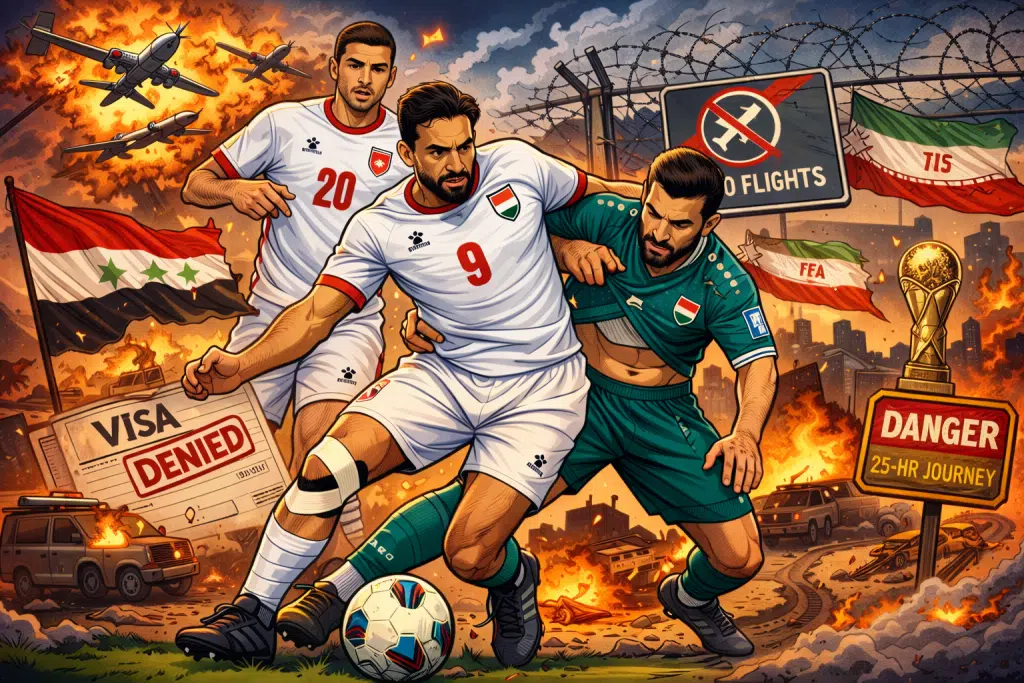
Football is built on moments of resilience, but sometimes the game is forced to deal with realities far beyond the pitch.
Iraq has now formally requested FIFA to postpone its intercontinental World Cup playoff scheduled for March 31 in Monterrey after rejecting a proposal that would require the squad to take a 25-hour road trip to Turkey before flying to Mexico.
With Iraqi airspace closed because of the ongoing war, travel has become a nightmare for the national team. Nearly half of the squad remains stranded in Baghdad, unable to leave the country, while head coach Graham Arnold is currently stuck in Dubai.
FIFA reportedly suggested that the players travel by road from Baghdad to Istanbul, but that route cuts through northern regions that have recently faced Iranian drone attacks. Arnold has made it clear he will not allow his players to risk such a dangerous journey during an active conflict.
The complications do not stop there. Several Iraqi players and staff members are still waiting for visas to enter Mexico and the United States, where the team had planned a pre-match training camp in Houston.
For a side that fought hard through Asian qualifying to reach the final stage of the six-team intercontinental playoffs, this disruption could not have come at a worse time.
Adding another twist to the situation is the wider regional uncertainty surrounding the World Cup itself.
If neighboring Iran is forced to withdraw from the tournament due to the ongoing war, Iraq could emerge as the most likely replacement based on the Asian Football Confederation rankings from the qualifying campaign a scenario shaped by the same geopolitical tensions affecting Iran.
For Iraq, the objective is simple: a fair chance to compete. Footballers are warriors on the pitch but asking them to travel through conflict zones just to reach a playoff crosses a line. The beautiful game has always been about courage, but it should never demand recklessness. Now the ball is firmly in FIFA’s court.